Inxy AI SEO is live on the Shopify App Store
The weekly loop we have been running on our own stores for months is now one install away — audit, fix, publish, and see which pages earned the orders.
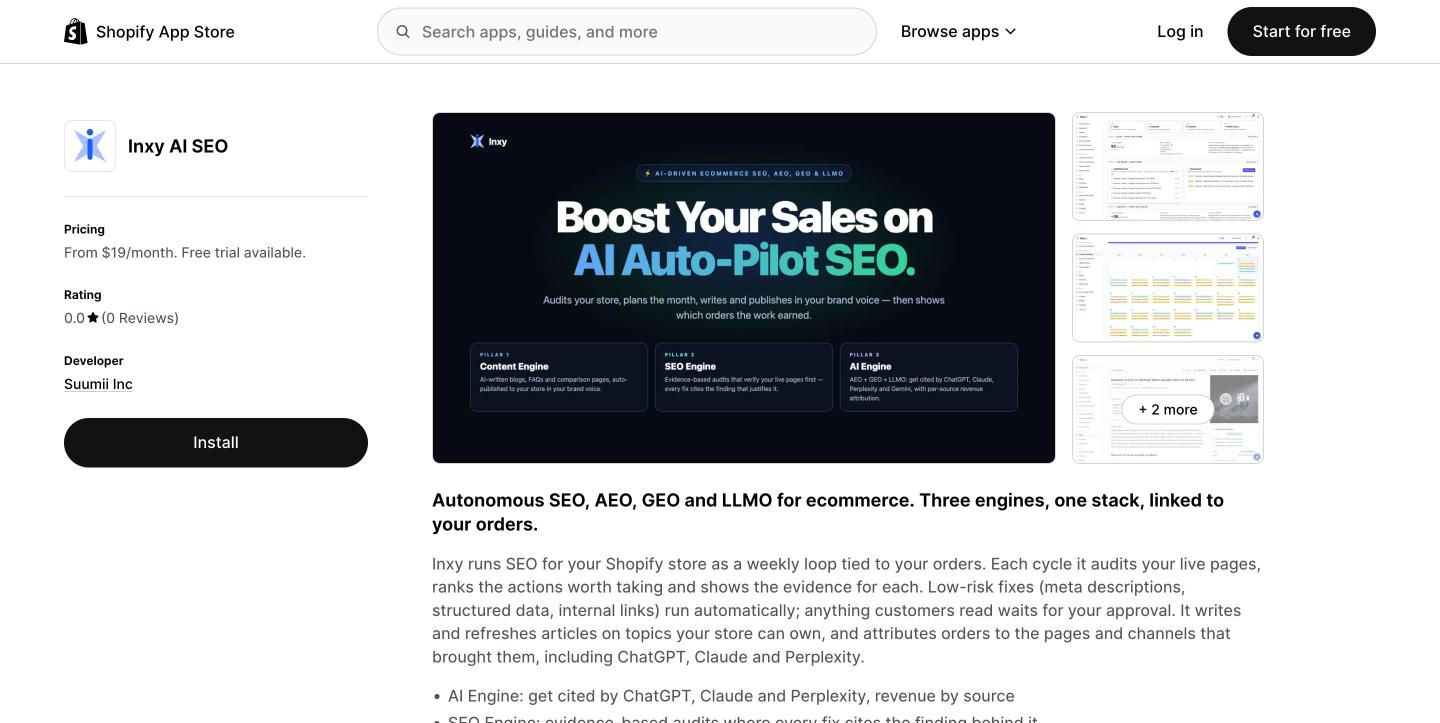
Inxy AI SEO is live on the Shopify App Store. One install, a 14-day free trial, and the loop starts on your store the same day.
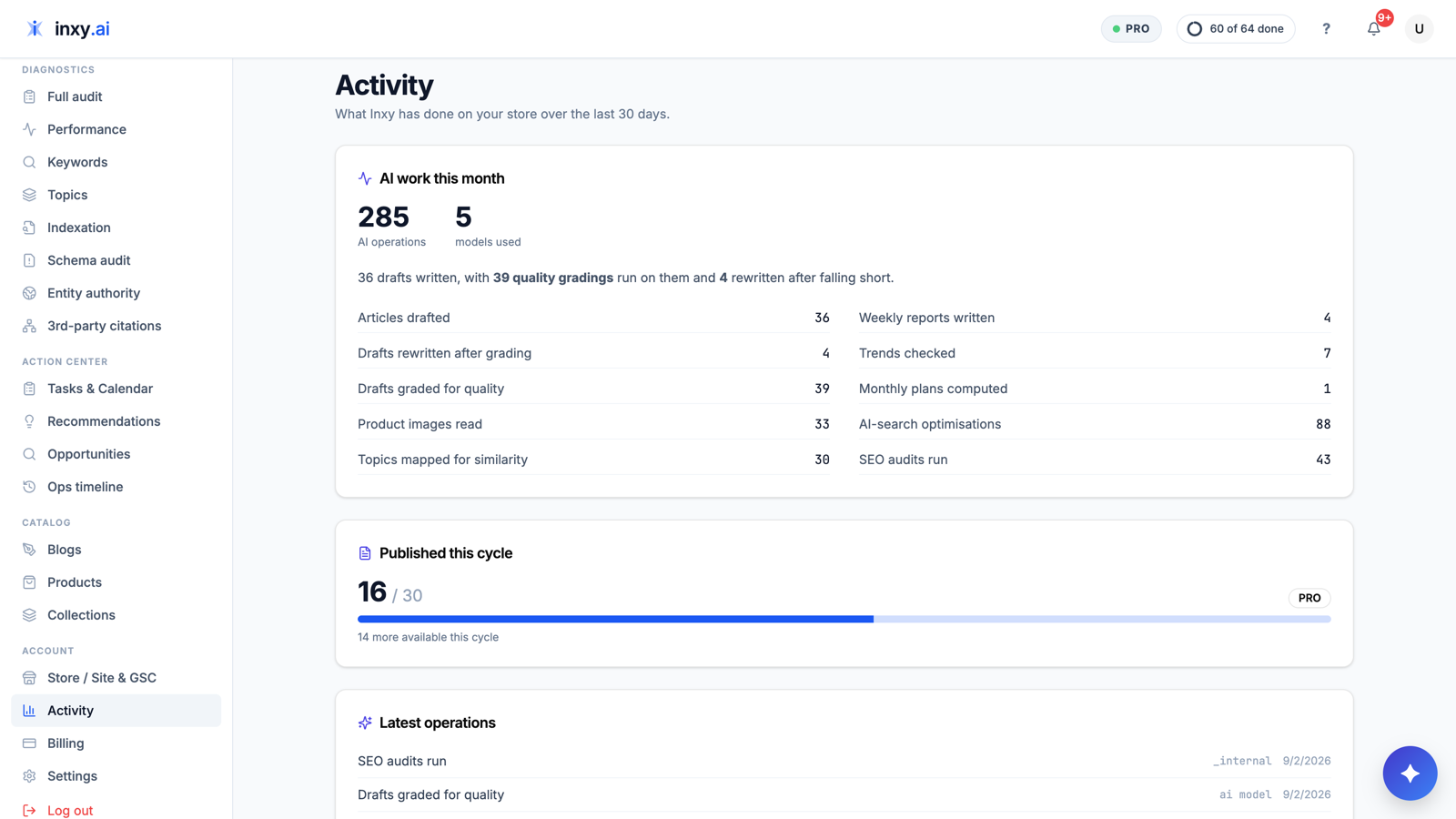
We built it because SEO tools tend to stop at the diagnosis. You get a report with forty problems, and then you are the one who has to write the schema, rewrite the meta descriptions, publish the articles and check whether any of it moved. Inxy closes that gap: it does the work, on a schedule, and shows you the evidence behind every change.
What one week looks like
Every cycle runs the same four steps on your live pages, not on a cached copy of them.
- · Audit — 12 scored categories measured on the pages a shopper actually loads: technical SEO, mobile and desktop performance, structured data, content, indexation, entity authority and more.
- · Plan — the findings are ranked into a 30-day plan of dated tasks, each one carrying the finding that justifies it.
- · Execute — the low-risk fixes run on their own; anything a customer reads waits for you.
- · Measure — Search Console and GA4 come back the following week to say whether the page moved and whether it earned anything.
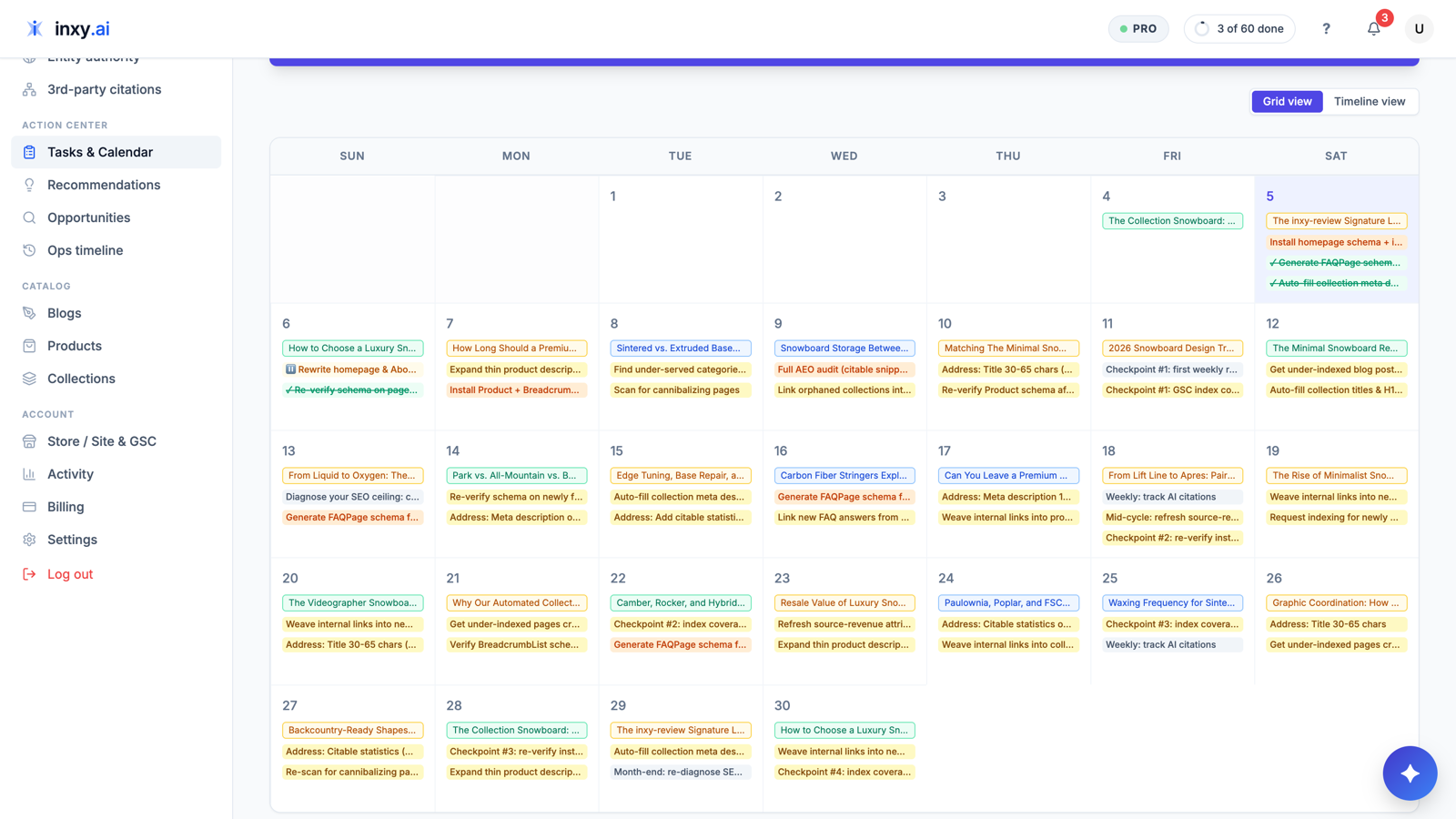
What it changes without asking, and what it never does
This is the line that matters most when you let software into your storefront, so we made it explicit rather than clever.
Runs automatically: meta titles and descriptions, JSON-LD schema (Product, Article, FAQ, Breadcrumb), canonical tags, internal links, llms.txt and robots directives for AI crawlers. These are measurable defects with one correct answer, and every one of them is reversible from the app.
Waits for your approval: anything a customer reads. New articles, rewritten collection descriptions, product copy, merges and redirects. They sit under "Waiting for your approval" with the reasoning attached, and nothing ships until you say so.
A page you have edited by hand can be locked. Inxy checks that lock before every write and skips the page — an automated writer never overrules a person.
The three Google connections, and what each one is actually for
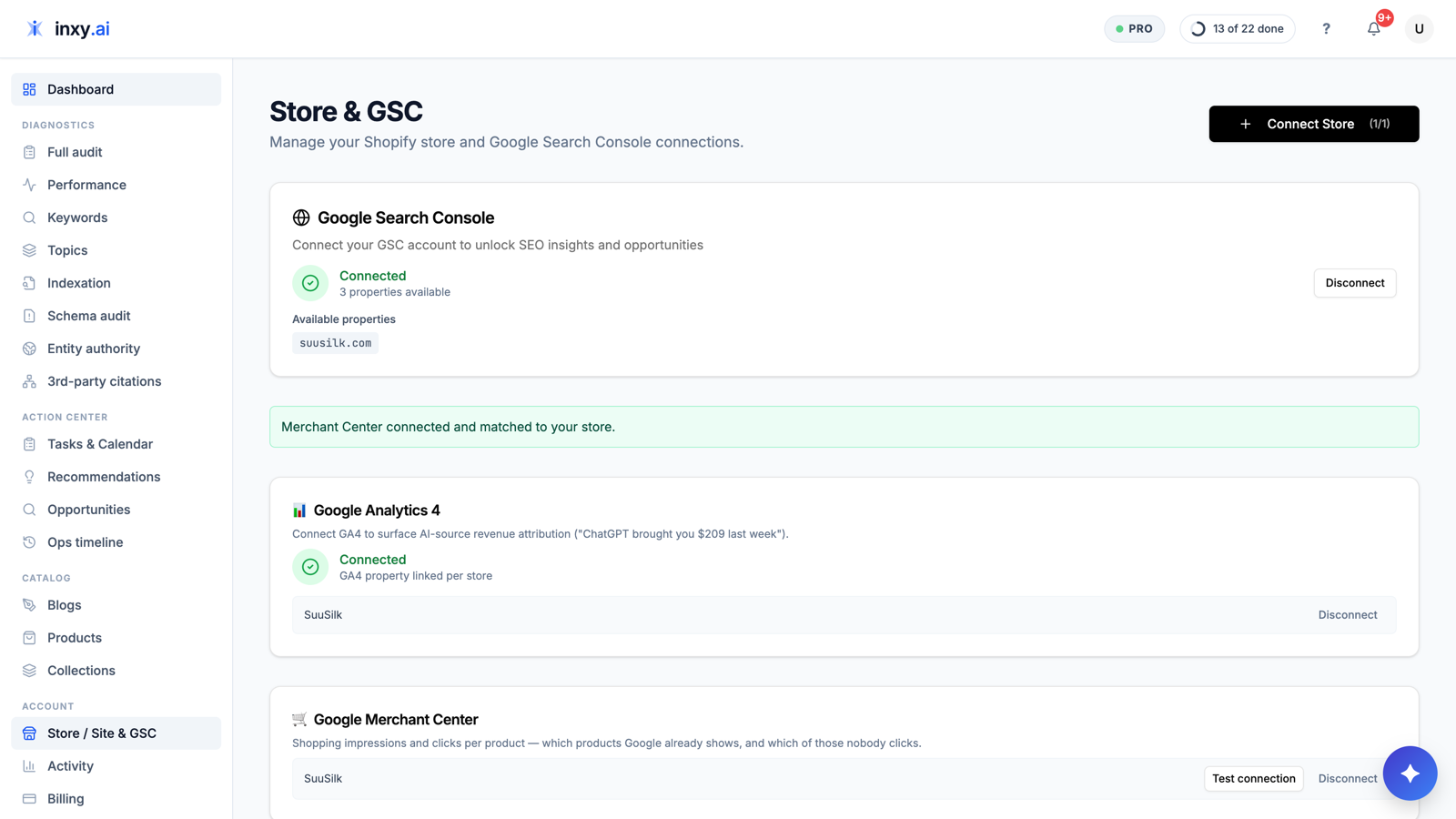
Most tools ask for Search Console and stop. Each connection answers a different question, and together they are what lets Inxy talk about orders instead of impressions.
- · Search Console — which of your keywords are sitting on page 2, where a small fix is worth more than a new article.
- · Google Analytics 4 — which page earned the order, so content is judged on revenue rather than sessions.
- · Merchant Center — why a product is disapproved or missing from Shopping, which is usually a feed problem no blog post will fix.
Written for answer engines, not only for Google
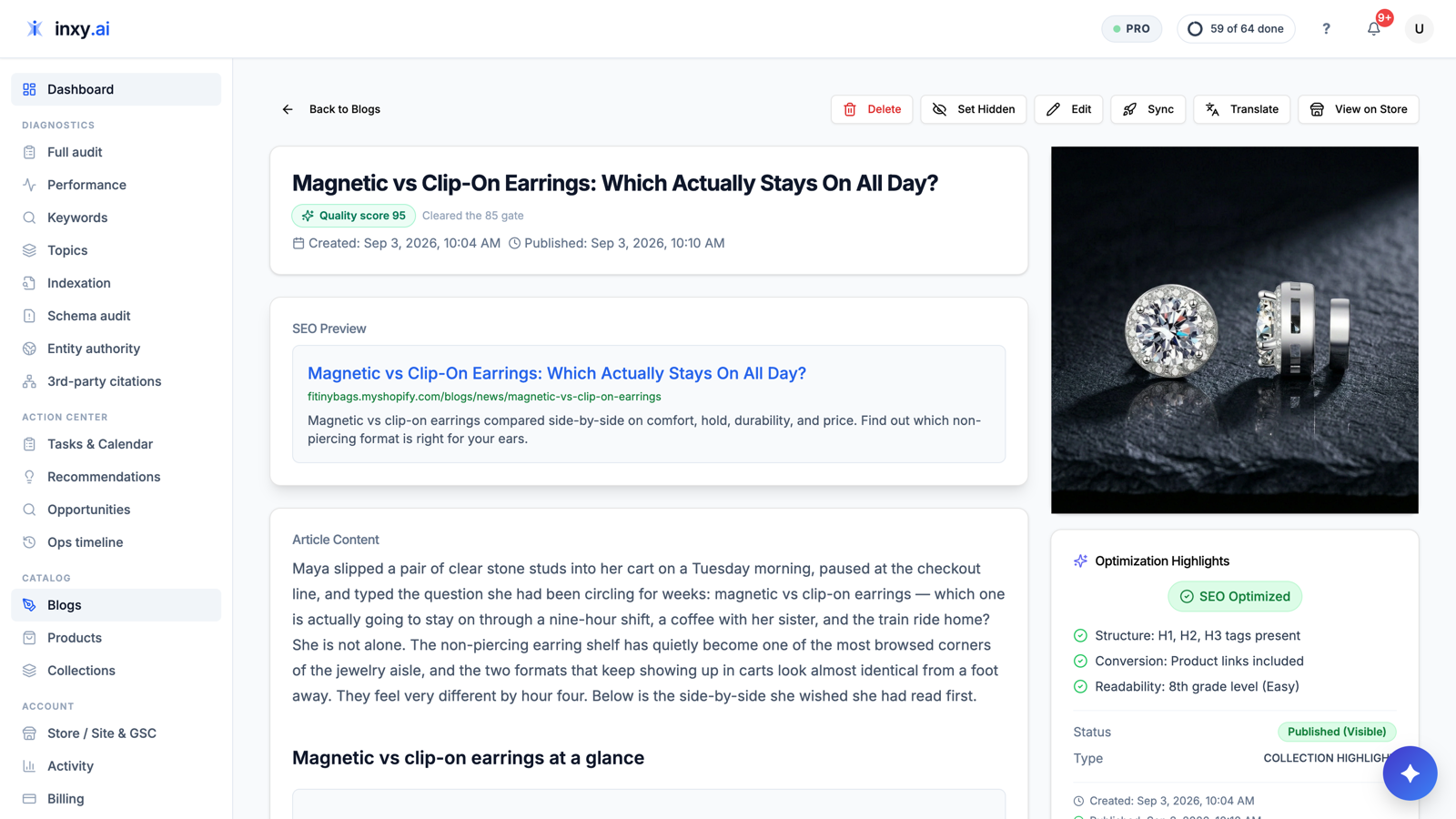
A growing share of product research now happens inside ChatGPT, Claude, Perplexity and Gemini, and those engines quote pages rather than rank them. Inxy writes for that: answer-first structure, explicit entities, FAQ and comparison pages, and an llms.txt that tells AI crawlers what your store is about. It then tracks where you are being cited.
What we learned running it on our own stores
Inxy has been running on our own Shopify stores for months before this listing existed, and two findings changed the product more than anything else.
The first is that collection pages are where structured data quietly breaks. On our own store, the collection template rendered an ItemList whose entries carried a URL and nothing else — valid, and useless to an engine trying to summarise the page. Naming each item was a one-line change with an outsized effect on how the page reads to a machine.
The second is what the coverage looks like once a store is fully instrumented. On one of our own stores Inxy now tracks 2,715 distinct search queries across 59,911 impressions — a brand term sitting around position 2 and the main category term on page one. No single number there is remarkable; what matters is that every one of them is measured on the live page and tied back to a task, so nothing in the plan is a guess.
The third changed what we build. Auditing that store's revenue by source turned up orders arriving from ChatGPT and Meta AI that Google Analytics cannot see at all — the referrer is stripped, so the sale lands in Direct and the page that earned it gets no credit. We wrote up how we found it in Why GA4 cannot see your AI search revenue. It is the reason Inxy attributes orders itself rather than trusting the analytics default.
And a report nobody acts on is worth nothing. Our free audit has now run 1,143 times, 305 of them on Shopify stores, and the sites with real problems were rarely the ones missing an audit — they were the ones where the audit had been read and nothing happened next. That is the entire reason the app executes rather than reports.
Getting started
Install from the Shopify App Store, connect the store, and the first audit runs within a few minutes. Every plan includes a 14-day free trial — Shopify charges nothing until it ends, and you can cancel from your Shopify admin at any time.
If you would rather see the diagnosis before installing anything, run the free audit on inxy.ai. It works on any public URL, needs no account for the summary, and it is the same engine the app uses.
Install Inxy AI SEO on the Shopify App Store: apps.shopify.com/inxy-ai-seo
Want Inxy to do this for your store?
Connect Shopify + GSC + GA4 in 60 seconds. The first weekly Recommendations Engine output lands within a day. 14-day free trial, no credit card required.